How ISO 22301 Enables Businesses to Prepare, Respond, and Recover from Disruptions

Article Summary
ISO 22301 provides a globally recognised framework for identifying critical operations, assessing risks, and ensuring rapid, coordinated recovery from disruptions. Organisations that adopt ISO 22301 strengthen operational resilience, meet regulatory expectations, and gain competitive advantage by demonstrating preparedness, reliability, and trustworthiness in an increasingly volatile environment.Article Contents
Introduction
In today’s volatile business environment, disruptions are no longer a possibility, they are a certainty. From cyberattacks and natural disasters to supply chain breakdowns and geopolitical tensions, organisations face increasing threats that can halt operations and damage stakeholder trust.
The ISO 22301 standard, the international benchmark for Business Continuity Management Systems (BCMS), provides a structured, scalable framework for preparing for, responding to, and recovering from disruptions. Organisations that adopt ISO 22301 not only mitigate operational risk but also gain competitive advantage by demonstrating resilience to customers, regulators, and investors.
In this article, we explore why business continuity matters now more than ever, examine the key components of ISO 22301, and outline a roadmap for successful implementation.

Why Business Continuity is Mission-Critical
“Disruptions are inevitable, but organisational collapse is optional.”
Over the past decade, the frequency and impact of disruptive events have accelerated. According to McKinsey research, companies now face a significant disruption every 3-7 years, with the potential to erase up to 30% of one year’s EBITDA during a major event.
The drivers of this new risk landscape include:
1. Global Supply Chain Fragility
- Increasing reliance on complex, cross-border networks has created new vulnerabilities.
- Events such as pandemics exposed how a single point of failure can ripple across industries.
2. Cybersecurity Threats
- In some countries Ransomware attacks have more than doubled year-on-year.
- Breaches now carry not only financial loss but also reputational damage and regulatory penalties.
3. Climate Change and Natural Disasters
- Extreme weather events are more frequent and severe, disrupting manufacturing, logistics, and energy systems.
4. Geopolitical and Regulatory Shifts
- Trade wars, sanctions, and political instability have direct operational implications.
Companies that are unprepared for these challenges face prolonged downtime, loss of customer confidence, and potential regulatory non-compliance.
Conversely, resilient organisations recover faster and capture market share while competitors struggle
Introducing ISO 22301: The Global Standard for Business Continuity
ISO 22301 is the first international standard designed to help organisations build, maintain, and continually improve a BCMS.
At its core, the standard is built on the Plan-Do-Check-Act (PDCA) cycle, ensuring continuous improvement and alignment with organisational objectives.
Key Objectives of ISO 22301:
- Identify critical operations and dependencies across the enterprise.
- Assess and mitigate risks related to potential disruptions.
- Develop robust response and recovery plans that are regularly tested.
- Ensure compliance with legal, regulatory, and contractual obligations.
- Enhance organisational reputation by demonstrating a commitment to resilience.

Core Components of ISO 22301
A robust BCMS under ISO 22301 is structured around several interconnected elements:
Context and Leadership
The foundation begins with understanding the organisation’s context:
- Mapping internal and external factors that affect continuity.
- Establishing governance structures with executive sponsorship.
- Aligning business continuity goals with strategic objectives.
Insight:
Leadership commitment is critical. Without top-down support, BCMS initiatives often remain siloed and underfunded.
Business Impact Analysis (BIA)
The BIA identifies:
- Critical processes and assets essential to operations.
- Recovery Time Objectives (RTO) and Recovery Point Objectives (RPO) for each function.
- The financial and reputational impact of disruptions.
Risk Assessment
Complementing the BIA, risk assessment evaluates:
- The likelihood and severity of potential threats.
- Vulnerabilities within systems, processes, and supply chains.
- Prioritisation of risks to guide mitigation investments.
Common risks assessed:
- Cyber incidents
- Power failures
- Key supplier disruptions
- Workforce unavailability
- Natural disasters
Business Continuity Strategies and Plans
Based on insights from the BIA and risk assessment, organisations define:
- Continuity strategies, such as alternate sites, cloud backups, and redundant suppliers.
- Detailed response plans for different disruption scenarios.
- Communication protocols to keep stakeholders informed during crises.
Testing and Exercising
Plans are only as effective as their execution. ISO 22301 mandates:
- Regular tabletop exercises and live simulations.
- Post-incident reviews to identify gaps and lessons learned.
- Continuous refinement to adapt to changing conditions.
Performance Evaluation and Continuous Improvement
A BCMS is not static. Ongoing monitoring ensures:
- Key performance indicators (KPIs) track preparedness and response times.
- Internal audits and management reviews drive accountability.
- Integration of findings into the next PDCA cycle.
Benefits of ISO 22301 Adoption
Organisations that implement ISO 22301 gain tangible and intangible advantages:
Operational Resilience
- Faster recovery times minimise revenue loss and customer churn.
- Improved coordination across departments during crises.
Regulatory Compliance
- Meets or exceeds requirements for sectors like finance, healthcare, and government contracting.
- Reduces legal exposure through documented processes.
Market Differentiation
- Certification demonstrates commitment to resilience.
- Enhances trust among customers, partners, and investors.
Cost Efficiency
- Identifies inefficiencies and redundancies during risk assessments.
- Aligns continuity investments with actual risk exposure.
Implementation Roadmap
Successfully adopting ISO 22301 requires a structured approach. Below is a recommended five-phase roadmap:
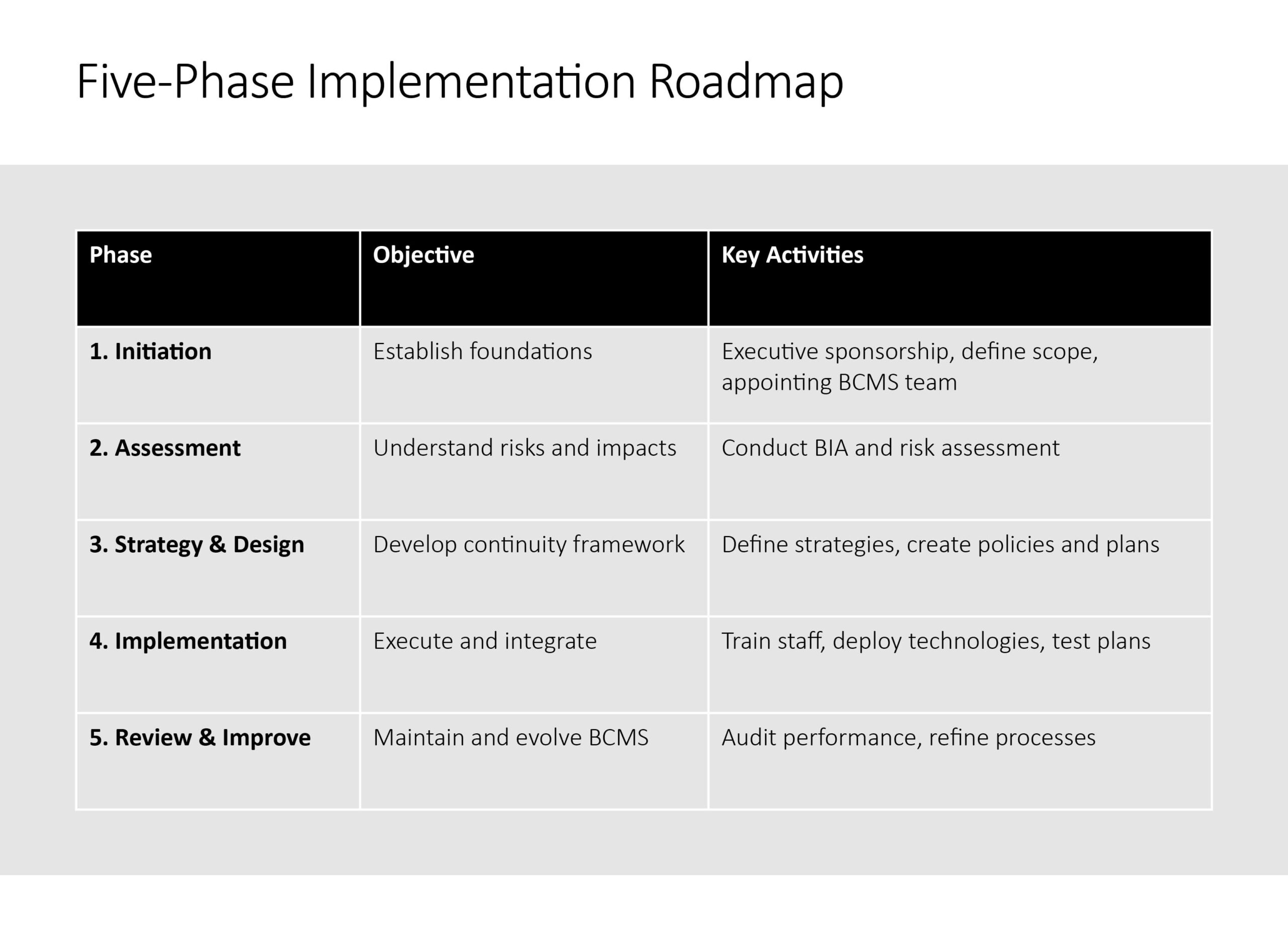
Five-Phase ISO 22301 Implementation Roadmap
Critical Success Factors
1. Leadership Engagement
- Resilience must be positioned as a strategic priority, not just an operational task.
2. Cultural Alignment
- Employees should understand their role in continuity and feel empowered to act during crises.
3. Integrated Risk Management
- BCMS should align with enterprise risk management, cybersecurity, and supply chain functions.
4. Technology Enablement
- Leverage tools such as cloud-based recovery platforms, automated alert systems, and data analytics.
5. External Validation
- Third-party certification builds external trust and provides objective performance feedback.

Challenges and How to Overcome Them
Challenge:
- Lack of executive buy-in.
- Resistance to change.
- Complexity in global operations.
- Limited resources.
Mitigation Strategy:
- Demonstrate ROI through data-driven scenarios.
- Conduct awareness campaigns and training.
- Standardise processes while allowing local flexibility.
- Prioritise high-impact areas first; scale over time.
Looking Ahead: Business Continuity as a Competitive Advantage
The future of business continuity goes beyond mere survival. Organisations that embed resilience into their DNA will emerge stronger from crises, outperform competitors, and build lasting stakeholder trust.
Three emerging trends will shape the next evolution of BCMS:
1. Digital Resilience
- Integration with cybersecurity to address growing digital threats.
2. Supply Chain Transparency
- Real-time visibility into supplier risks through advanced analytics.
3. Sustainability Alignment
- Linking continuity planning with environmental, social, and governance (ESG) goals.
Conclusion
In today’s volatile environment, disruptions are inevitable, but organisational unpreparedness is a choice.
ISO 22301 provides a clear, structured framework that enables companies to:
- Anticipate risks through systematic identification and assessment.
- Respond decisively with tested strategies and coordinated action.
- Recover rapidly to restore critical operations and minimise impact.
By implementing a robust Business Continuity Management System (BCMS), organisations can safeguard operations, strengthen stakeholder trust, and differentiate themselves competitively in the marketplace.
In an era defined by uncertainty, business continuity must be viewed not merely as a defensive posture, but as a strategic driver of resilience, growth, and long-term success.
References
Disclaimer. The views and opinions expressed in this article are solely those of the author and do not necessarily reflect the official policy or position of Test Labs Limited. The content provided is for informational purposes only and is not intended to constitute legal or professional advice. Test Labs assumes no responsibility for any errors or omissions in the content of this article, nor for any actions taken in reliance thereon.
Get It Done, With Certainty.
Contact us about your testing requirements, we aim to respond the same day.
Get resources & industry updates direct to your inbox
We’ll email you 1-2 times a week at the maximum and never share your information