Designing for Both Sides of the Stethoscope: How Human-Centred AI Could Transform Women’s Heart Care

Article Summary
Women remain underdiagnosed and underserved in cardiovascular care, and digital health tools largely replicate these gaps. This study shows how human-centred, co-designed AI could better support both patients and clinicians by balancing lived experience with workflow realities.Article Contents
When Care Pathways Don’t Fit Women
Cardiovascular disease (CVD) remains the leading cause of death worldwide, yet women continue to be under-recognised, under-diagnosed, and under-supported across the care continuum. Symptoms often present differently in women, diagnoses are delayed, and disease management rarely reflects hormonal changes or life stages such as pregnancy or menopause.
This gap is not limited to traditional care. It is clearly mirrored in today’s digital health landscape. In a previous review of commercially available tools, the research team found that only 25% of cardiovascular apps and 40% of wearables included any sex-specific features. Digital solutions, much like standard care, largely fail to reflect women’s lived realities.
These findings formed the starting point for a new study published in JMIR Human Factors, which asked a critical question: How can digital health tools be designed to genuinely meet women’s needs, while still fitting into real clinical workflows? The study was designed to address this dual gap in both cardiovascular care and digital health technology. Rather than beginning with features or algorithms, the research started with people.

Understanding the Gap Between Patient Experience and Clinical Workflows
One of the findings of the study was how patient and clinician needs differ, and at times directly conflict.
Women living with CVD described:
- Difficulty recognising early or atypical symptoms
- A lack of trustworthy, sex-specific information
- Emotional distress and uncertainty, particularly around diagnosis
- A desire for personalised feedback and reassurance
Clinicians highlighted a different set of challenges:
- Diagnostic uncertainty driven by non-classical symptom presentation
- Severe time constraints and information overload
- A need for structured, actionable summaries, not continuous data streams
- Concerns about liability, data quality, and workflow disruption
From a human factors perspective, these tensions are critical. A tool that empowers patients but overwhelms clinicians is unlikely to be adopted. Equally, a system optimised purely for clinical efficiency risks failing the very people it is meant to support.
Why Co-Creation is Essential in Digital Health Design
To address these tensions, the study applied a human-centred, co-creation approach, involving women with cardiovascular disease and cardiologists in parallel qualitative interviews. This made it possible to identify:
- Where priorities align (e.g. symptom tracking, sex-specific education)
- Where expectations diverge (e.g. real-time alerts versus periodic summaries)
- What a balanced design would need to look like to achieve acceptance from both groups
Rather than forcing a single “ideal user”, the findings point toward dual user pathways: patient-facing features focused on empowerment and understanding, and clinician-facing features designed to minimise cognitive load and support decision-making.

How Artificial Intelligence Can Improve Women’s Cardiovascular Care
“If we want to close long-standing gaps in women’s cardiovascular care, we need to capitalise on cutting-edge AI in a way that respects both lived experience and clinical reality. The goal is not more data, but better, more meaningful signals that support earlier recognition and better decisions”, said the project’s lead, Christine Jacob. AI here is not framed as a replacement for clinicians, but as a way to address long-standing gaps that neither patients nor clinicians can solve alone.
Grounded in the co-creation findings, the proposed design explores how AI could support:
- Earlier symptom recognition, by identifying patterns across patient-reported symptoms, wearable data, and clinical history
- Missed or delayed diagnosis, through intelligent pattern detection in longitudinal and clinical data
- Improved disease management, using predictive analytics to anticipate deterioration and enable earlier intervention
- Life-stage and hormone-aware insights, recognising how menopause, pregnancy, and hormonal changes influence cardiovascular risk
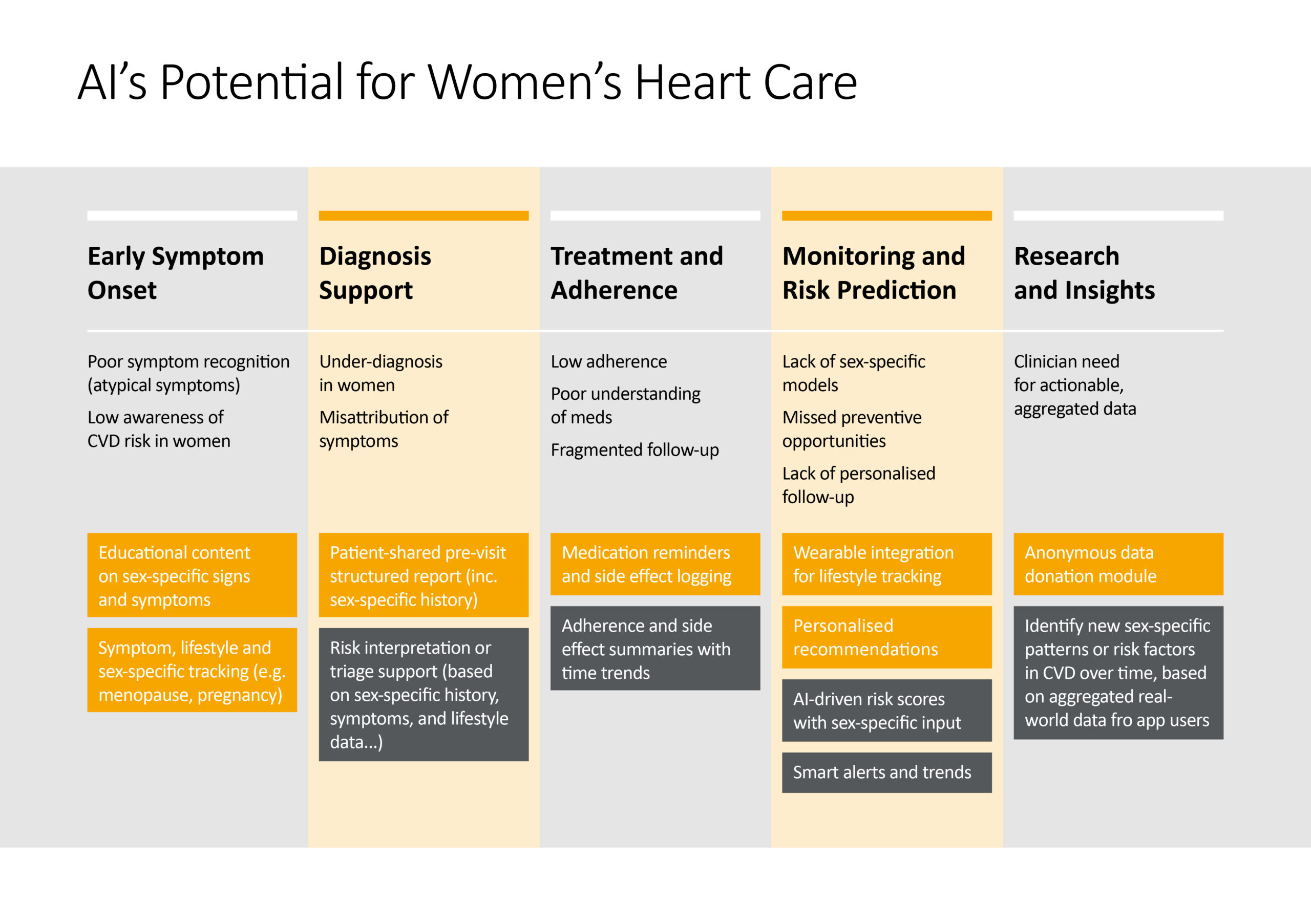
A conceptual framework illustrates how an AI-enabled digital tool could support women across the cardiovascular care continuum, from early symptom recognition to long-term disease management. The visual illustrates how patient-generated data, clinician oversight, and AI-driven insights could interact at different stages of care. It highlights where current gaps exist, and where thoughtfully designed digital support could help bridge them. Patient-facing features focus on supporting the lived experience of women navigating cardiovascular conditions, such as personalised education, symptom logging, and wearable-integrated tracking (in orange). Clinician-facing features prioritise workflow efficiency, diagnostic support, and data integration (in grey).
Translating AI Research Into Clinical Practice
Building on these findings, the researchers suggest that the next step will be real-world validation and development of the proposed tool. By starting with lived experience and explicitly addressing the tensions between patient empowerment and clinical integration, this research offers a practical blueprint for how AI-enabled health technologies can move from promise to practice, particularly in areas such as women’s cardiovascular health, where gaps have persisted for far too long.
References
- https://mhealth.jmir.org/2025/1/e65782
- https://humanfactors.jmir.org/2026/1/e82916
- Jacob et al. Bridging Gaps in Women’s Heart Health: User-Centered Needs Assessment Informed by Patient and Clinician Interviews. DOI: 10.2196/82916
Disclaimer. The views and opinions expressed in this article are solely those of the author and do not necessarily reflect the official policy or position of Test Labs Limited. The content provided is for informational purposes only and is not intended to constitute legal or professional advice. Test Labs assumes no responsibility for any errors or omissions in the content of this article, nor for any actions taken in reliance thereon.
Get It Done, With Certainty.
Contact us about your testing requirements, we aim to respond the same day.
Get resources & industry updates direct to your inbox
We’ll email you 1-2 times a week at the maximum and never share your information