Clinical Strategy: Planning Evidence in a Shifting Landscape

Article Summary
Clinical evaluation is a continuous, strategic process that underpins both regulatory approval and commercial success for medical devices. Early alignment on intended purpose, clinical strategy, and evidence generation is critical. Tools such as the Target Product Profile and State of the Art review help define clinical value, risks, and evidence gaps. When integrated across regulatory, clinical, and commercial teams, clinical evaluation becomes a competitive advantage.Article Contents
Introduction
The medical device and medtech landscape is changing rapidly. Technology-driven innovations are outnumbering those of a purely physical nature. Regulations worldwide are evolving to try and keep pace with these changes, whilst healthcare systems are being impacted by geopolitical issues and the ever-increasing costs of paying for an aging population. For a new device to be commercially successful it has to navigate this landscape and have strong evidence of value to clinicians, patients and/or healthcare systems.
Clinical Evaluation: The Foundation of Medical Device Evidence
Clinical evaluation is defined under EU MDR as “a systematic and planned process to continuously generate, collect, analyse and assess the clinical data pertaining to a device in order to verify the safety and performance, including clinical benefits, of the device when used as intended by the manufacturer”. Note the word “continuous”. It is not an activity that is ever complete for as long as that product remains on the market. Documented evidence of this process is critical to a successful submission to regulators around the world. Fundamentally the process ensures medical devices that are placed on the market are safe, effective in delivering clinical benefits that outweigh risks and remain so for as long as they are on the market.
Continual evidence gathering is also a means of driving commercial success. The methods vary and can be tailored to fit the purpose, so managing costs. The data may result in greater understanding of the ideal patient, extending indications, or supporting cost-effectiveness as healthcare evolves.
Clinical strategy relies heavily on the clinical evaluation process. Step one is to capture some headline information and then dive into the literature to ensure there is a solid understanding of the environment the product will be going into.
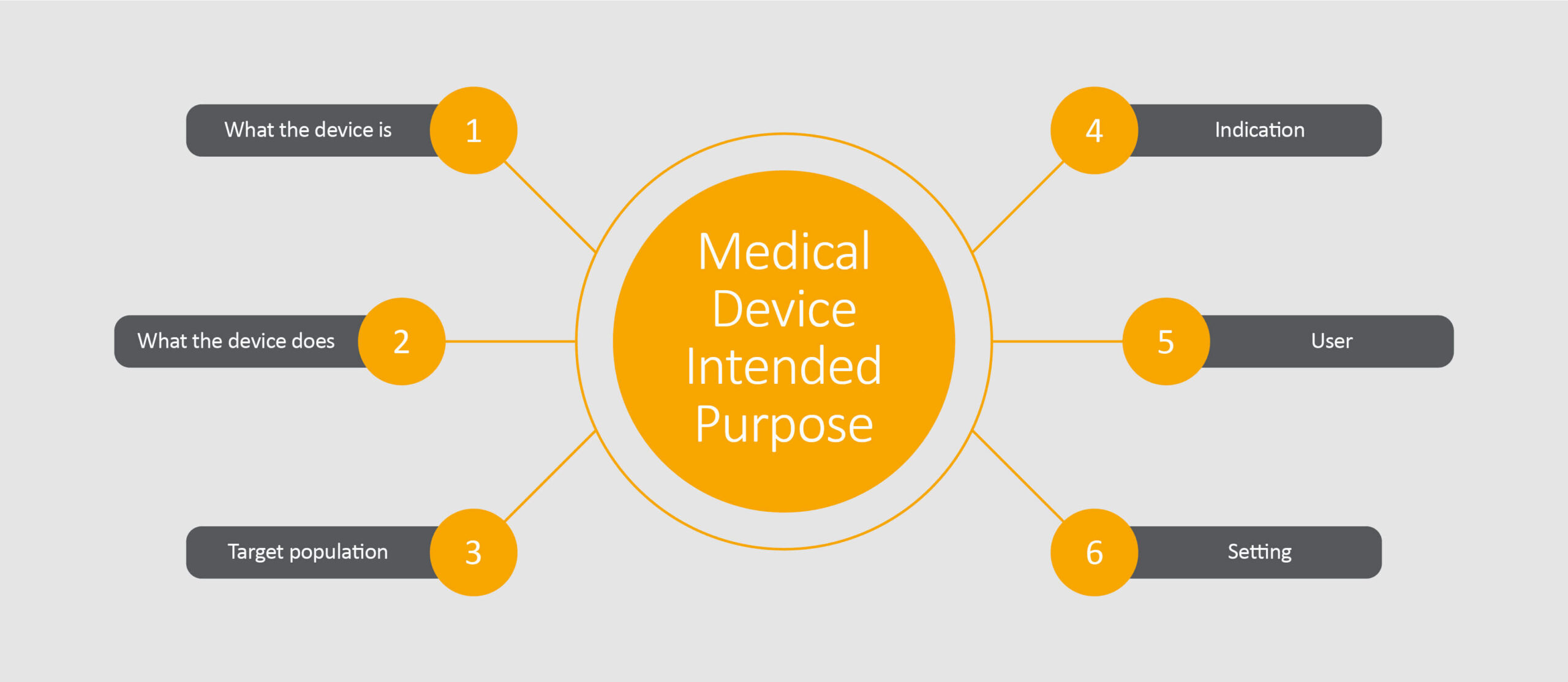
It all starts with the intended purpose. In defining the intended purpose there needs to be consideration of:
- What the device is (e.g. physical, software, how it interacts with the body)
- What the device does (e.g. diagnostic, therapeutic, monitoring, energy delivery, sample collection, structural support.)
- Target population (e.g. adult, paediatric, specific disease subgroups)
- Indication (e.g. lung cancer, sinusitis)
- User (e.g. healthcare professionals with a certain level of training, patient for self-care)
- Setting (e.g. hospital setting, home care)
The earlier these elements are specified, the more efficiently evidence generation can be planned. Starting clinical evaluation at proof-of-concept or prototype stage yields better alignment between product design, regulatory expectations and market needs.
Why Clinical Evaluation Requires Cross-Functional Collaboration
Attempting to conduct clinical evaluation in isolation is doomed to failure. There are too many interdependencies and inputs required from different specialties to enable the process to be conducted well by a single person, without involvement of a wider team. If you’re a solo innovator you will need to gather and incorporate different perspectives from the clinical community (ideally all types of HCPs who would engage with the product), patient groups, procurement decision-makers and regulatory experts to name a few. This will give you a broader perspective and understanding of how a change in one aspect can impact many other elements of the go-to-market plan.

Using a Target Product Profile to Align Clinical, Regulatory and Commercial Strategy
One way to ensure full alignment and capture key attributes is to develop a Target Product Profile (TPP). This supports the whole go-to-market strategy, by triggering discussions that highlight interdependencies and refine thinking to really shape the course of the product development. Particularly in the early stages when a product is moving from proof of concept to development stage, the TPP enables the team to consolidate what exactly is being developed, for what purpose and what it aims to achieve commercially.
Typical section headings would be:
- Product description – what is it, how does it function, what information does it deliver, what are the clinical benefits?
- Intended Purpose – as already discussed this is critical to all that will follow
- Regulatory – classification and path to approval for key markets (e.g. under FDA is it a 510K, de novo or PMA route? What classification does it fall under in different regulatory jurisdictions?)
- Commercial – what are the key claims to be made and what is the comparator for each claim (e.g. is it superior to standard of care or is it equivalent to a competitor product?). Mapping out the claims in this way really helps with evidence planning, whether it be benchtop testing or clinical data that is required.
- Market Access – how will it be reimbursed, what pricing limitations might there be, who are the key decision makers, are there Health Technology Assessments for this type of product? This informs clinical study design in terms of how product value needs to be demonstrated.
- Clinical input – what workflows are impacted? Are behaviour changes required and by which users? Are the anticipated clinical benefits sufficient to justify any behaviour change required? What data is currently generated within the existing workflow, which could be a useful real world data source in future?
- Ideally there would be patient input as well. How this is gathered and to what extent will depend upon the device. For example, if it is a self-use device patient input is critical, in terms of usability (of the instructions as well as the device), impact on daily living and expected outcomes. However, for surgical implants the patient input would have a different emphasis, such as which clinical outcomes are the most important to the patient.
The value of the TPP is not the document itself, but the discussions it triggers. For example, a bold claim to enable an ambitious growth plan, may require evidence that comes with a large cost. The team needs to consider if that is acceptable and how that decision impacts the Intended Purpose, and the value proposition of the product. Surfacing such trade-offs early helps prioritise evidence generation that delivers the highest commercial and clinical value.
State of the Art Reviews: Understanding Existing Evidence and Unmet Needs
Whilst you may know your field well, it is important to get a comprehensive view of existing evidence and what other devices are used in that therapeutic space. A State of the Art review (SOTA), compliant with EU MDR and MedDev 2.7/1 rev4, will summarise all the clinical data on similar devices and alternative treatments in your target indications, as well providing clinical context, current care pathways and unmet needs, along with the risks that are associated with different treatments.
From the clinical data evaluated within this report the relevant clinical outcome parameters are defined along with what is considered acceptable values for each of those parameters, effectively setting the safety and effectiveness targets for your product. This is therefore a critical part of the process in designing a clinical evidence strategy, determining the outcome measures to be included in a clinical study or those that need to be captured in post-market clinical follow-up activities. Similarly the risk profile of your device will be informed by the State of the Art review and these findings should be incorporated into the risk management documentation. This then feeds into the clinical evidence planning in a similar way, making sure that both the benefits and risks of the device are measured and used to inform the benefit-risk assessment.

Turning Clinical Evidence into Commercial Advantage
With the SOTA and TPP in hand, a robust clinical strategy can be developed. The knowledge gleaned through developing the TPP, from the SOTA and any other intelligence that has been gathered, a clinical evidence generation plan can be designed that maximises the efficiency in terms of time and commercial value.
A good clinical strategy will factor in: regulatory requirements across markets; evidence requirements of payers who may demand randomised controlled trials or health economic data to justify reimbursement; clinical practice realities (the level of evidence required to justify a small behavioural change will differ from significant workflow adjustments); and, consideration of where the data is to be generated in terms of location and population. A robust clinical strategy will consider all these angles and result in a plan of evidence generation activities that encompasses different means of generating evidence at different stages (pre- and post-market) and in different forms (studies and real world evidence), ultimately giving what is needed to support commercial success.
Clinical Evaluation Documentation: Supporting Compliance Without Losing Focus
With a clinical strategy developed, clinical evaluation documentation comes back into play, particularly if you are including European sites within your evidence generation activities. The Clinical Evaluation Plan is required for Ethics Committee and/or Competent Authority submissions for approval to conduct a clinical investigation. The CEP documents the existing evidence, from benchtop, through pre-clinical and any clinical evidence on the subject device, and concludes what evidence gaps remain to demonstrate compliance with the GSPRs. The plan to fill the gaps are presented within this document to show that there is a clear path to meet all the clinical evidence requirements of the regulation.
The outcomes of the plan are reported in the Clinical Evaluation Report (CER). The CER submitted to a Notified Body would be the primary document to support the clinical safety and effectiveness of the product, and how it complies with the relevant GSPRs. As CERs are updated on a regular cycle post-approval (the frequency of which is dependent on the classification of the product), these documents are critical records of all the available evidence available on the device (including the data captured in the PMCF Report). Over time any changes in risk profile will need to be reported, alongside the developing body of data around effectiveness. Ultimately it is this document that provides the Notified Body with the justification as to why the benefit-risk profile of the device is acceptable and the device is safe and effective. With each iteration the benefit-risk assessment has to be repeated and in the case of the benefits no longer outweighing the risks the Notified Body is duty-bound to withdraw certification of the device.
Why Continuous Clinical Evidence is Key to Long-Term Market Success
Clinical evaluation is never “done”, it is continuous and being strategic in your evidence generation, will give you a stronger commercial position. Evidence has an expiry date, particularly in changing landscapes. The success rates of procedures change and therefore patient expectations change. New tools can impact workflows and therefore efficiencies may be lost. Getting to market is a great milestone to reach, but clinical evidence that makes you a market success requires strong foundations and that is where a robust clinical strategy pays dividends.
Disclaimer. The views and opinions expressed in this article are solely those of the author and do not necessarily reflect the official policy or position of Test Labs Limited. The content provided is for informational purposes only and is not intended to constitute legal or professional advice. Test Labs assumes no responsibility for any errors or omissions in the content of this article, nor for any actions taken in reliance thereon.
Get It Done, With Certainty.
Contact us about your testing requirements, we aim to respond the same day.
Get resources & industry updates direct to your inbox
We’ll email you 1-2 times a week at the maximum and never share your information