Protecting Capital: The Case for Service Validation

Article Summary
Ignoring service architecture during device development embeds financial risk, regulatory exposure, and margin erosion into your product before it reaches the market. Validating service design before tooling freeze is critical to ensure safe, efficient field performance and protect long-term commercial viability.Article Contents
The Service Gap in Medical Device Design
Currently, there is a massive gap between Design for Manufacture (DFM) and Design for Service (DFS). Ignoring this Service Gap will guarantee the erosion of your post market margins. During medical device development, teams are mandated to consider DFM. Somewhere along the way, someone might mention service in a design meeting, but it is treated as an afterthought rather than a validated process. Throughout the entire programme, you hire specialists to ensure each phase is executed correctly, yet service is ignored until the first unit fails in the field. By that point, it is already too late. You are no longer engineering; you are just firefighting problems to keep the hardware running, all because the physical architecture of the unit was locked months ago.

Tooling Freeze Locks in Service Risk
Once tooling is cut, the physical layout and build of the medical device is locked. If post market deployment reveals that accessing a high failure rate component requires the removal of a primary PCBA, a critical financial and regulatory liability has been hard coded into the product.
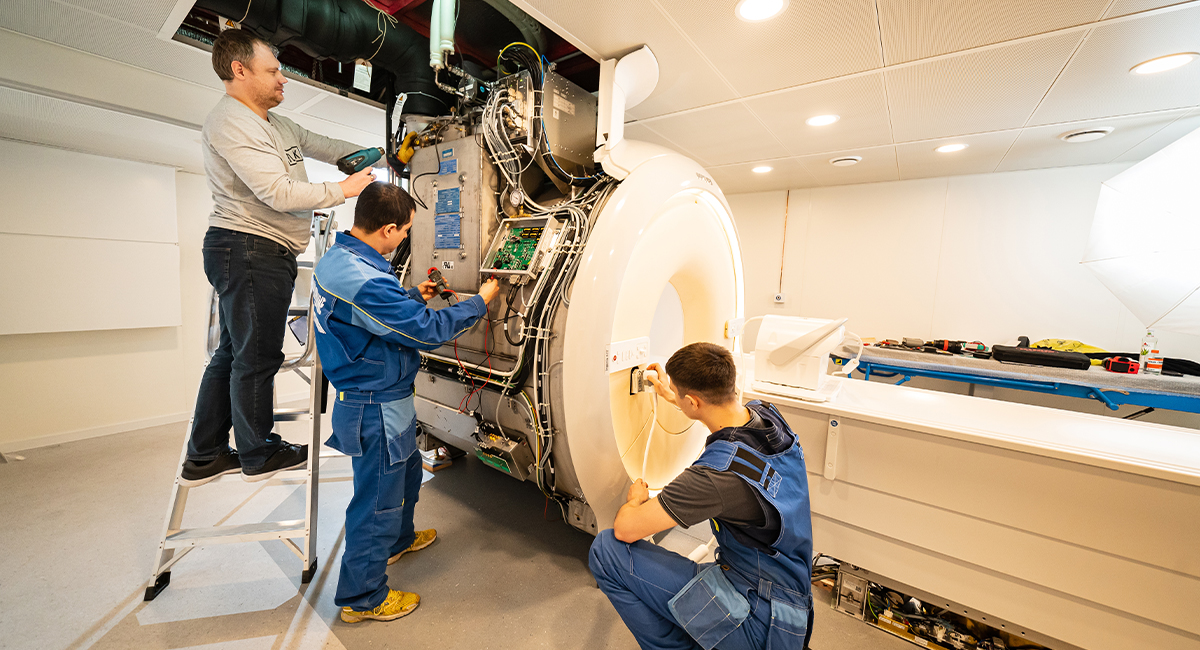
In a controlled manufacturing environment, sequentially removing a PCBA is a validated, ESD compliant procedure. It makes perfect sense when you are assembling the device on the line. However, out in the field, forcing a Field Service Engineer (FSE) to strip down unrelated, critical sub-assemblies to access a minor fault introduces severe operational risk. You are mandating the handling of sensitive electronics in an uncontrolled environment, drastically increasing the probability of secondary, service induced failures.
Every time that unit requires intervention, your operating margin absorbs the extended labour costs, and your Quality Management System absorbs the unvalidated risk. Forcing complex physical teardowns guarantees a compounding rate of secondary field failures. Attempting to correct this geometric failure after the fact is no longer a matter of engineering hours. Modifying a hard tool to create a simple access clearance can easily consume £40,000 in unbudgeted capital and introduce a 12-week programme delay. You are burning runway to fix a preventable error.
Design vs Field Reality
It stands to reason that a Design Engineer will look at a medical device differently to a Service Engineer. They operate in entirely different realities. Design is done in CAD, with iterations built in slow time on a well-lit, temperature-controlled bench. It is methodical, supported by regular meetings to resolve issues as they arise.
Field service is the exact opposite. It is executed under severe pressure from customers, management, and caseloads. FSEs operate in tight physical constraints with clinical staff moving around them, all while navigating strict, site-specific rules. They are potentially diagnosing complete systems at 2 AM using a torch because the ambient light is inadequate.
Deciphering a customer complaint and translating it into a functional repair is complicated enough. Burying a high-wear Field Replaceable Unit (FRU) behind a primary control board does not just frustrate the technician. If replacing a £50 component takes four hours instead of twenty minutes, the £150 hourly field labour rate will instantly consume the profit margin of that deployed unit.
You do not need to look far to see the catastrophic financial impact of ignoring this. Between 2015 and 2019, Apple locked their MacBook design geometry using a ‘butterfly’ keyboard switch, permanently riveting the keyboard into a top-case assembly that also housed the glued-in battery. When a single key failed due to microscopic dust ingress, technicians could not replace the individual 50p switch. The lack of a modular FRU forced an £800 replacement of the entire top case. This single geometric failure resulted in a $50 million class-action settlement, bled hundreds of millions in extended warranty repairs, and ultimately forced Apple to abandon the entire tooling architecture.
Service Validation and Regulatory Compliance
To prevent costs spiralling out of control, service architecture cannot be left until you are fielding live failures. Doing so is the equivalent of throwing random documents together and asking a Notified Body to audit your QMS just to find out where your gaps are.
ISO 13485 Clause 7.5 mandates validated service documentation. An R&D engineer can certainly write a procedure that technically satisfies the standard on paper. But does that document make sense to an FSE working under pressure? Does it reflect the physical reality of the clinical environment?
Under ISO 14971, you are required to detail risks to the users of the device. FSEs are a distinct user type and must be explicitly profiled in your risk file. If that FSE is forced to remove the primary control board mentioned earlier just to reach a secondary component, you have introduced a severe, unvalidated risk.
Complex field teardowns naturally increase the probability of inducing secondary faults. You would not build a QMS without a QARA specialist verifying the architecture before an audit. Service architecture demands the exact same premarket validation to protect both the patient and your operating capital.
Post-Market Data, CAPA, and Investor Risk
As part of your service architecture, you must establish a robust field reliability loop. If you rely on ad hoc reporting, such as simply expecting FSEs to write detailed notes in a CRM, you will receive vague data like ‘part failed, replaced‘. Without pre validated diagnostic pathways engineered during R&D, you cannot correctly identify if a fault is an isolated failure or a systemic complaint. If you cannot classify it, you cannot determine if it warrants a Corrective and Preventive Action (CAPA). This data vacuum is severely magnified if you lack an established service network and simply receive hardware back as ‘No Fault Found‘ (NFF).
An NFF result on the R&D bench is the ultimate indicator that your field data collection is failing. As discussed, R&D operates in a climate-controlled vacuum. A clinical environment might experience severe temperature spikes during summer months, causing thermal shutdowns that resolve once the unit cools. If your service architecture does not mandate the capture of these environmental variables at the point of failure, you lose the root cause. An NFF ticket is not a closed case; it is a regulatory liability. If you cannot reproduce the fault, you cannot prove the device remains safe under MDR/IVDR.
Post-Market Surveillance is a strict requirement under ISO 13485:8.2.1. Failing to structure this data loop cripples your compliance and directly threatens future capital. When VCs conduct due diligence, escalating warranty costs and unresolved NFF returns are immediate red flags. If your CAPA log proves your field interventions are uncontrolled, investors will devalue the company or halt Series B funding entirely.
Service Validation Protects Margin and Compliance
Integrating service infrastructure before the CAD freeze is not an operational preference; it is mandatory corporate governance. A validated service architecture ensures you can definitively identify faults, standardise the physical intervention, and capture the exact data required to drive engineering revisions.
Hardware giants with limitless capital struggle to absorb the financial penalty of unvalidated service geometry. A scaling MedTech cannot. Freezing a design without this architecture guarantees compliance failure and margin erosion.
Disclaimer. The views and opinions expressed in this article are solely those of the author and do not necessarily reflect the official policy or position of Test Labs Limited. The content provided is for informational purposes only and is not intended to constitute legal or professional advice. Test Labs assumes no responsibility for any errors or omissions in the content of this article, nor for any actions taken in reliance thereon.
Get It Done, With Certainty.
Contact us about your testing requirements, we aim to respond the same day.
Get resources & industry updates direct to your inbox
We’ll email you 1-2 times a week at the maximum and never share your information