Future EU Regulatory Pathways: Breakthrough and Orphan Devices

Article Summary
The European Commission has proposed new regulatory pathways under EU MDR for orphan and breakthrough medical devices, aiming to speed access for rare disease treatments and highly innovative technologies. These routes would allow expert panel designation, prioritised notified body review, and approval based on limited clinical data supported by robust non-clinical evidence and PMCF.Article Contents
What is an Orphan or Breakthrough Medical Device?
On 16th December 2025 the European Commission published 2025/0404(COD), a proposal for an amendment of four regulations including (EU) MDR 2017/745 being applicable to medical devices. The intention of the proposal is to develop a framework for simplifying and reducing the burden of the rules on medical devices and in vitro diagnostic medical devices.
As part of this proposal, the amendments describe the introduction of a conformity route for breakthrough devices and orphan devices. The concepts of these designated pathways have not existed thus far in the EU medical device regulatory landscape.
This Article will focus on these potential regulatory pathways for medical devices under (EU) MDR 2017/745.
It is important to state here that 2025/0404(COD) is still only a proposal and not the final amendment to the regulation. Changes are expected between now and the adoption of the final, amended legislation.

Proposed Definitions Under EU MDR Article 48a and 52a
This proposal introduced two wholly new articles, Article 48a and Article 52a, that define what may be considered an Orphan Device and a Breakthrough Device:
Orphan Device:
- it is intended for the treatment, diagnosis, or prevention of a disease or condition that presents in not more than 12 000 individuals in the Union per year;
- at least one of the following criteria is met:
(i) there are insufficient available alternatives;
(ii) the device is expected to provide a clinical benefit compared to available alternatives or the state of the art, taking into account both device-specific factors and patient population-specific factors.
Breakthrough Device:
- it is expected to introduce in the Union a high degree of novelty with respect to the device technology, related clinical procedure or the application of the device in clinical practice; it is expected to provide a significant positive clinical impact on patients or public health, for a life-threatening or irreversibly debilitating disease or condition, by either of the following:
(i) offering a significant positive clinical or health impact compared to available alternatives and the state of the art;
(ii) fulfilling an unmet medical need where there is an absence or insufficiency of available alternative options for that purpose.
Simplified Interpretation of the Definitions
To summarise these criteria, perhaps at the risk of oversimplifying:
An orphan device is intended for the treatment of a rare disease within the European Union and expected to provide a significant benefit in comparison to current practices and medical devices on the market.
A breakthrough device shows a superior technology or high novelty to current available treatments and specifically for life-threatening or irreversibly debilitating disease.
This shows a distinct difference in the definitions in that the orphan device is focused on the disease or condition, whereas the breakthrough device is focused on the technology and the standard of care.
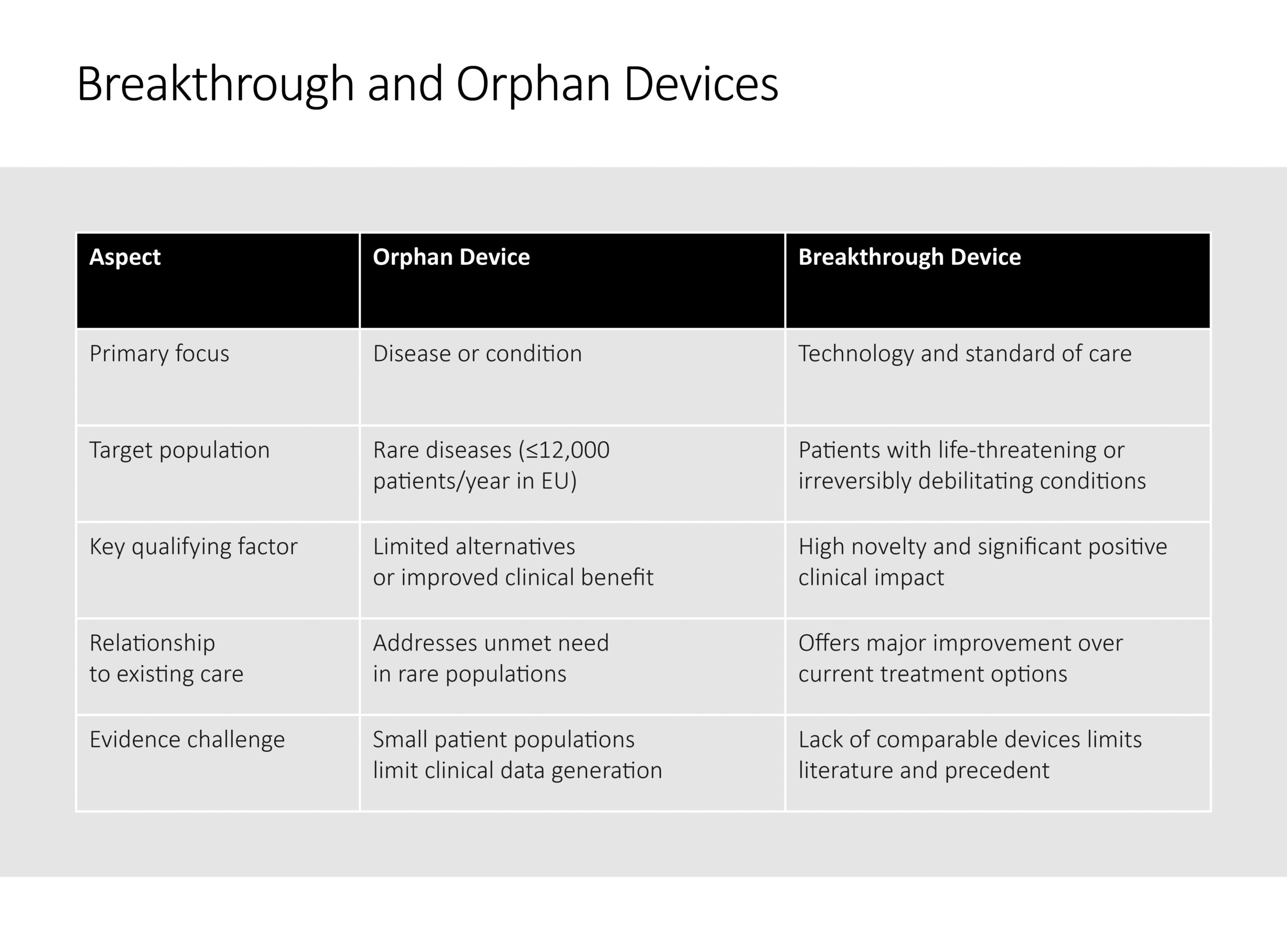
Orphan vs Breakthrough Devices (Comparison Table)
Comparable Regulatory Pathways in the US and Pharmaceuticals
Categorising devices as Orphan or Breakthrough devices is not a new concept and similar regulatory pathways exist in different regulatory bodies, as well as within the field of pharmaceuticals.
The U.S. Food and Drug Administration (FDA) have introduced a similar route with the Humanitarian Use Device (HUD) Designation Program in which the applicant must demonstrate the device is indicated for a rare disease or subset of a disease. Depending on the target patient population, this program is available to devices which are intended to benefit patients of conditions affecting fewer than 4000 or not more than 8,000 individuals in the United States per year.
After a HUD designation has been achieved, a Humanitarian Device Exemption (HDE) application must be submitted to bring the device to market.
Since 2016 the FDA also offer the Breakthrough Devices Program, a voluntary program for medical devices that provide for more effective treatment or diagnosis of life-threatening or irreversibly debilitating diseases or conditions.
The intention of this route to market is to expedite the assessment and review while maintaining standards for premarket approval, 510(k) clearance, and De Novo marketing authorisation.
Data in the past 5 years via this pathway has granted up to 206 annual designations* with the majority of these in the areas of Cardiovascular, Neurology and Orthopaedics.
*Data accurate as of 20th August 2025
Turning to similar pathways in the EU but in the pharmaceuticals, the European Medicines Authority has an orphan designation. Regulation (EC) 141/2000 originally adopted in December 1999 and applicable to medicines intended to treat, prevent or diagnose disease which
- are life-threatening or chronically debilitating
and - the prevalence of the condition in the EU must not be more than 5 in 10,000.

Key Conditions of the Proposed EU Orphan and Breakthrough Pathways
Much like the similar pathways described above, in the 2025/0404 (COD) proposal of EU MDR designation of Orphan or Breakthrough status will be decided by a medical device expert panel.
Once designated, the manufacturer may request advice from the expert panel regarding appropriate analytical or clinical performance data. The expert panel’s advice will be considered by the notified body.
Following designation and conformity assessment, a certificate may be issued ‘even if based on limited clinical data’ providing the benefit outweighs the risk if made available on the market immediately. In such situations, the manufacturer may commit to providing data from Post Market Clinical Follow Up (PMCF) activities, possibly within a limited time period.
Given the nature of these devices, the patients they serve and absence of technology and available treatments on the market, notified bodies will offer prioritised review for breakthrough and orphan devices. These may be “rolling reviews” with submissions made in stages as data and documentation becomes available.
Some key points of the proposal were made in relation to orphan devices.
One stipulation benefitting manufacturers of designated orphan devices is reduced notified body fees for conformity assessment activities.
Interestingly, and although not being a route to market, legacy devices on the market under EU MDR Article 120 may be allowed market access after the translational periods. This may occur under certain conditions if the orphan status is designated and the device has no design changes or unacceptable risks to patients or public.
Clinical Evidence Challenges and Existing MDCG Guidance
MDCG 2024-10, released back in June 2024 provided initial guidance around MDR requirements for orphan devices, addressed the challenges in generating data for small patient populations and defining a sufficient level of clinical data. This guidance also includes information on manufacturers and notified bodies requesting voluntary expert panel advice for both orphan device status and clinical strategy.
In the latest proposal, taking this expert panel advice into consideration now appears to be mandated by notified bodies in the proposed regulatory pathway, Article 52a.
A key question for both pathways is: What is adequate when preparing limited clinical data? MDCG 2025-9 was made available from December 2025 providing guidance on breakthrough devices including premarket clinical evidence.
The very definition of breakthrough devices infers that clinical literature is unavailable on a device with equal novelty therefore clinical data on the subject device is invaluable. The time to generate this data must however be balanced with the appetite of the market for an innovative device, potentially treating a life-threatening or debilitating disease.

Role of Non-Clinical Testing and Alternative Evidence Generation
With such limited study subjects being available in the case of devices indicated for rare orphan diseases, pre-market clinical data may be either insufficient or contentious.
Although not a substitute, reduced clinical data calls for robust and thorough non-clinical data to satisfy safety requirements, such as bench testing including verification and validation with the use of relevant standards (if available).
Reliable testing pertinent to the subject device in the form of laboratory testing, simulated use testing, animal testing and In silico modelling may perform as risk controls, characterise device components and predict the performance and safety of a device in the clinical setting.
Regulatory Interpretation and Future Considerations
If the proposal is legislated, manufacturers will pay close attention to the interpretation of the expert panel designations: how accepted are subpopulations of more common disease in being designated as “orphan”? How novel is a device required to be for breakthrough consideration?
Although the orphan and breakthrough pathways may only impact few medical device manufacturers, if introduced, they may be a welcome amendment in increasing speed to market. This change will incentive manufacturers, support innovation and benefit those with the most rare and serious conditions.

Next Steps
The 2025/0404(COD) proposal is moving through the legislative process with adoption of the Regulation by the co-legislators expected by Q2 2027.
- Manufacturers should monitor this through to the final amendment of (EU) MDR 2017/745, adapting to changes made to eligibility criteria or requirements that may affect access to the orphan or breakthrough pathways.
- With known clinical data restrictions, priority for manufacturers should be on early planning of non-clinical testing as part of design verification and showing clear linkage between this testing and device risk management.
- Clinical study plans are best developed for short to medium term clinical benefit and patient safety, with a comprehensive PMCF plan describing future activities to generate longer term evidence.
- Equipped with available data, a testing plan and clinical strategy, prepare for early engagement with expert panels to seek orphan or breakthrough device designation and benefit from consultation on clinical development strategy.
References
- EUR-Lex – 52025PC1023 – EN – EUR-Lex
- https://www.fda.gov/industry/medical-products-rare-diseases-and-conditions/humanitarian-use-device-hud-designation-program
- Humanitarian Device Exemption (HDE) Program | FDA
- Orphan designation: Overview | European Medicines Agency (EMA)
- https://www.fda.gov/regulatory-information/search-fda-guidance-documents/breakthrough-devices-program
- Breakthrough Devices Program | FDA
- MDCG 2024-10 Clinical evaluation of orphan medical devices
- MDCG 2025-9 Guidance on Breakthrough Devices (BtX) under Regulations 2017/745 & 2017/746
Disclaimer. The views and opinions expressed in this article are solely those of the author and do not necessarily reflect the official policy or position of Test Labs Limited. The content provided is for informational purposes only and is not intended to constitute legal or professional advice. Test Labs assumes no responsibility for any errors or omissions in the content of this article, nor for any actions taken in reliance thereon.
Get It Done, With Certainty.
Contact us about your testing requirements, we aim to respond the same day.
Get resources & industry updates direct to your inbox
We’ll email you 1-2 times a week at the maximum and never share your information